
4.85
(20 Ratings)

Reliability-Based Tools: Performance for Asset Management

Wishlist Share

About Course

Tools powering the P-CAM (Performance-Centered Asset Management) process

The participant go beyond the tools, to apply the lessons learned to his own context of operation, through workshops especially designed to self appropriate the fundamental principles;
– to develop a culture focused on Reliability-Centered Maintenance,
– to reach the right and sufficient level of detail for efficient analyzes,
– to directly link the information systems to the Reliability-Centered Maintenance analyzes,
– to understand the pitfalls to avoid in order to mobilize and engage people in the process.

This training is for people involved or having an interest in the management of physical assets, operational excellence or maintenance engineering, and looking for a new perspective.

Methodology: Through presentations, workshops and analytical exercises, the participant becomes familiar with the concepts of Reliability-Centered Maintenance (RCM), so that he can implement it in a sustainable way.
• Presentations (50%), analysis exercises (50%)

Outcome: The participant is outfitted with Reliability-Centered Maintenance (RCM) tools and understands their application to the Performance-Centered Asset Management (P-CAM) process while ensuring Global Sustainability ; People – Planet – Profit.

Content: This training session includes;
• 1 enthusiastic and passionate trainer who knows how to popularize to really transmit knowledge, tools, concepts and above all, know-how
• 8 lectures, each followed by a quiz to assess the knowledge learned and stimulate thinking
• 4 workshops, where the participant puts into practice the knowledge acquired in his own operational context
• 1 participant manual, including the full presentation, the RCM decision trees, the P-CAM process, workshops, lists of failure modes, causes, remedies, detection methods and associated maintenance activities, definitions and references used
• 1 asset classification tool, with standardized generic codes
• 1 Reliability-Centered Maintenance analysis tool, with standardized generic codes (programmed template)
• 1 nominative certificate of participation

Quality assurance: Training review to be completed after the session.

Assessment of the knowledge acquired by the participant: Quiz with a passing score of 80%, following each lecture.

TRAINING OUTLINE / SYLLABUS

Maintenance and reliability concepts (15%)
• Context and definitions
• Types of maintenance
• Dependability (RAMS)
• Operational indicators

Asset management concepts (10%)
• Analysis Process
• Classification tools
• Prioritization of assets

Reliability-Centered Maintenance (75%)
• Method’s origin and objectives
• RCM process and implementation
• Assets functional analysis
• RCM analysis and optimal maintenance plan
• Analysis vs failure reports

Show More

What Will You Learn?

  • - Define industrial maintenance and related concepts
  • - Define dependability (RAMS), reliability and related concepts
  • - Define Performance-Centered Asset Management (P-CAM) and related concepts
  • - Define Reliability-Centered Maintenance, role, objectives and related concepts
  • - Develop an optimal and sustainable maintenance plan from the RCM analysis

Course Content

Introduction to the Performance-Centered Asset Management training – RCM tools
By the end of this section, the participant will know what is the training about, who is the trainer and what attitudes to adopt to optimize the learning's benefits.

  • Introduction to the “Reliability-Based Tools; Performance for Asset Management” training
    04:53

Maintenance, reliability and P-CAM
By the end of this section, the participant will understand the basics required to sustainably develop an RCM culture, for the Performance-Centered Asset Management.

Reliability-Centered Maintenance (RCM)
By the end of this section, the participant will be able to efficiently conduct RCM analyzes in order to develop optimal and sustainable maintenance plans.

Examples, advantages and responsibilities
By the end of this section, the participant will see the process as a whole and will gain better understanding of how to self-appropriate and implement it in a sustainable way.

Extra material
By the end of this extra section, the participant will know about the Asset Management-Leader certification and the vision behind.

Earn a certificate

Add this certificate to your resume to demonstrate your skills & increase your chances of getting noticed.
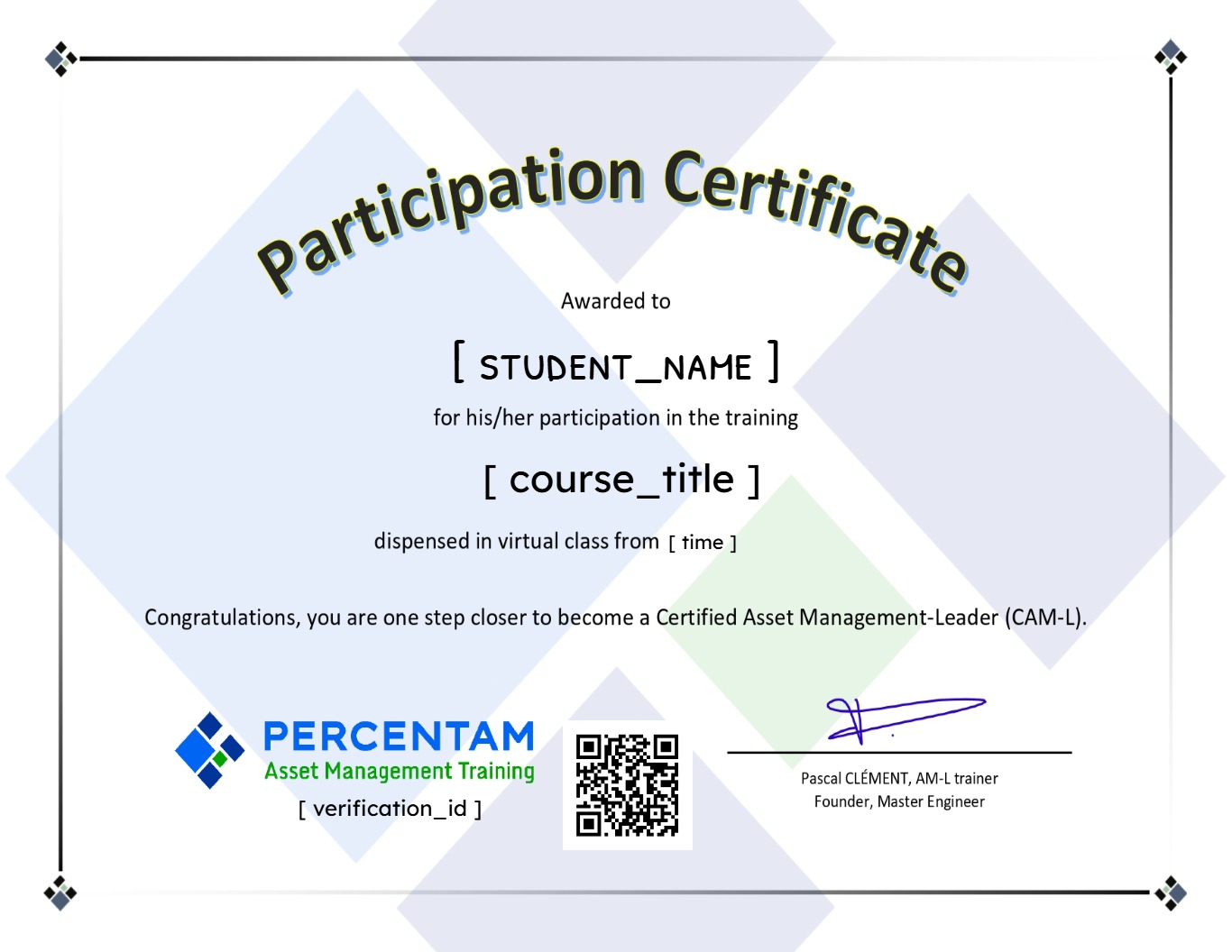
selected template

Student Ratings & Reviews

4.9
Total 20 Ratings
5
17 Ratings
4
3 Ratings
3
0 Rating
2
0 Rating
1
0 Rating
B
6 days ago
I would recommend this training to anyone involved in maintenance, reliability, or asset management. The course provides practical knowledge that can help organizations achieve more reliable and sustainable performance outcomes.
V
6 days ago
This training provided valuable insights into reliability engineering and asset management. The concepts were easy to understand, and the lessons were supported by practical examples from industry.
M
6 days ago
I enjoyed the training and found the material relevant to my responsibilities in maintenance planning. The reliability tools discussed can help organizations improve performance while reducing operational risks.
L
6 days ago
The training provided a strong understanding of how reliability tools contribute to sustainable asset management. I now feel more confident in my ability to support reliability improvement initiatives within my organization.
M
6 days ago
The course demonstrated how reliability tools can support better decision-making across maintenance and operations teams. I gained a deeper appreciation for the role of data and analysis in improving asset performance.
R
6 days ago
The content was clear, practical, and immediately useful. I particularly appreciated how the course connected reliability tools with continuous improvement initiatives and long-term asset management strategies.
F
6 days ago
The course highlighted the importance of using structured reliability tools rather than relying on assumptions or experience alone. It provided a disciplined approach to improving asset performance and reducing failures.
OS
6 days ago
The course was informative and practical. It explained how reliability tools can be integrated into everyday operations to improve performance and support continuous improvement objectives.
KG
6 days ago
This course offered a useful introduction to reliability-based tools and their role in improving asset management outcomes. The content was well presented, and the examples helped reinforce the key concepts.
M
6 days ago
This course offered practical insights into the role of reliability in asset management. The training was engaging, informative, and supported by examples that reflected real-world operational challenges.
D
6 days ago
I have attended several reliability-related courses in the past, but this one stood out because of its practical approach. The lessons focused on real-world application rather than theory alone, making the content highly valuable.
K
6 days ago
This training helped me understand why some organizations struggle with recurring equipment failures. The reliability tools discussed provide a systematic approach to identifying weaknesses and implementing effective solutions.
M
6 days ago
I appreciated the focus on performance improvement throughout the course. Reliability is not just about equipment; it is about achieving better outcomes for the entire organization. The course clearly demonstrated that connection.
J
6 days ago
I found the course highly relevant to my role in industrial operations. The tools and methodologies introduced can be applied across different industries and provide a structured way to improve reliability performance.
L
6 days ago
The reliability tools presented during this training have changed how I approach asset management challenges. I now have a better understanding of how to identify risks, prioritize actions, and focus resources where they will have the greatest impact.
J
6 days ago
The training provided a solid foundation in reliability engineering principles. More importantly, it explained how these principles can be translated into actions that improve equipment performance, reduce downtime, and support long-term business objectives.
G
6 days ago
As a maintenance engineer, I found this course extremely valuable. It demonstrated how reliability tools can be used proactively to prevent failures instead of simply reacting when problems occur. The practical examples helped bring the concepts to life.
J
6 days ago
One of the strengths of this training is its ability to simplify complex reliability concepts. The lessons were well organized and explained how different reliability tools contribute to asset management success. The content was relevant and easy to apply in real industrial environments.
K
6 days ago
This course provided a practical understanding of the reliability tools used to improve asset performance and operational efficiency. Before taking the training, I understood the importance of reliability but lacked a structured approach to applying it. The course bridged that gap and gave me practical methods that I can use in my daily work.
A
6 days ago
Reliability is often discussed in theory, but this course focused on practical application. The tools introduced during the training helped me understand how to identify performance gaps, reduce failures, and improve decision-making. I left the course with knowledge that can immediately benefit my organization.
Select your currency