
4.83
(12 Ratings)

Reliability & P-CAM: In-depth Reliability and data analysis

Wishlist Share

About Course

Reliability tools to measure and push P-CAM (Performance-Centered Asset Management) further

The participant goes beyond simple theory, to learn the language of assets, interpret their messages and continually evaluate the strategies put in place for optimal and sustainable performance;
– to understand the link between reliability theory, associated algorithms and the field,
– to adapt theories to their own operational context using the P-CAM process,
– to develop benchmarks to facilitate decision-making for asset management,
– to continuously improve the strategies in place, monitoring the associated results,
– and most importantly; to avoid drowning in trivial details.

This training is for people involved or having an interest in the management of physical assets, operational excellence or maintenance engineering, and looking for a new perspective.

Methodology: Through presentations and analytical exercises, the participant becomes familiar with the concepts of dependability, so that he can use them in a process of continuous improvement.
• Presentations (50%), analysis exercises (50%)

Outcome: The participant makes the data talk to provide an overview to target assets of concern. He acquires the knowledge and tools for analyzing dependability (RAMS) to optimize strategies based on field data driven decisions.

Content: This training session includes;
• 1 enthusiastic and passionate trainer who knows how to popularize to really transmit knowledge, tools, concepts and above all, know-how
• 14 lectures, each followed by a quiz to assess the knowledge learned and stimulate thinking
• 34 analysis exercises, where the participant puts into practice the knowledge acquired to eventually adapt it to his own operational context
• 1 participant manual, including the full presentation, the P-CAM process, exercises, lists of failure modes, causes, remedies, detection methods and associated maintenance activities, definitions and references used
• 34 solutions to the exercises presented, each programmed in an Excel spreadsheet
• 1 graphical method example
• 1 reliability models validation method
• 1 set of graphical papers, including exponential and Weibull papers
• 1 set of statistical tables, including the Chi-square and the Normal law tables
• 1 nominative certificate of participation

Quality assurance: Training review to be completed after the session.

Assessment of the knowledge acquired by the participant: Quiz with a passing score of 80%, following each lecture.

TRAINING OUTLINE / SYLLABUS

Dependability (15%)
• Reliability
• Availability
• Maintainability
• Safety

Reliability (20%)
• Laws of reliability
• Bathtub curve concepts
• Exponential model
• Weibull model
• Parts replacement time

Measuring Reliability (45%)
• Complete data
• Truncated/censored data
• Confidence interval
• Graphic methods
• Models validation

Improve reliability through redundancy (20%)
• Serial systems
• Parallel systems
• Majority systems
• Pending systems
• Mixed systems

Show More

What Will You Learn?

  • - Define dependability (RAMS) and associated concepts
  • - Define reliability, bathtub curve and associated models
  • - Estimate reliability from operating data
  • - Optimize reliability using redundancies

Course Content

Introduction to the Performance-Centered Asset Management training – In-depth reliability and data analysis
By the end of this section, the participant will know what is the training about, who is the trainer and what attitudes to adopt to optimize the learning's benefits.

  • Introduction to the “Reliability and P-CAM – In-depth Reliability and data analysis” training
    09:08

Dependability, the RAMS
By the end of this section, the participant will understand the basics concept of Dependability (RAMS) and associated operational indicators

Reliability concepts and laws
By the end of this section, the participant will understand the laws of reliability and how to use them efficiently without losing oneself in too many details.

Measuring Reliability
By the end of this section, the participant will be able to extract information from operating data to develop Performance-Centered Asset Management strategies.

Improve reliability through redundancy
By the end of this section, the participant will understand the basic configurations to optimize asset reliability.

Extra material
By the end of this extra section, the participant will know about the Asset Management-Leader certification and the vision behind.

Earn a certificate

Add this certificate to your resume to demonstrate your skills & increase your chances of getting noticed.
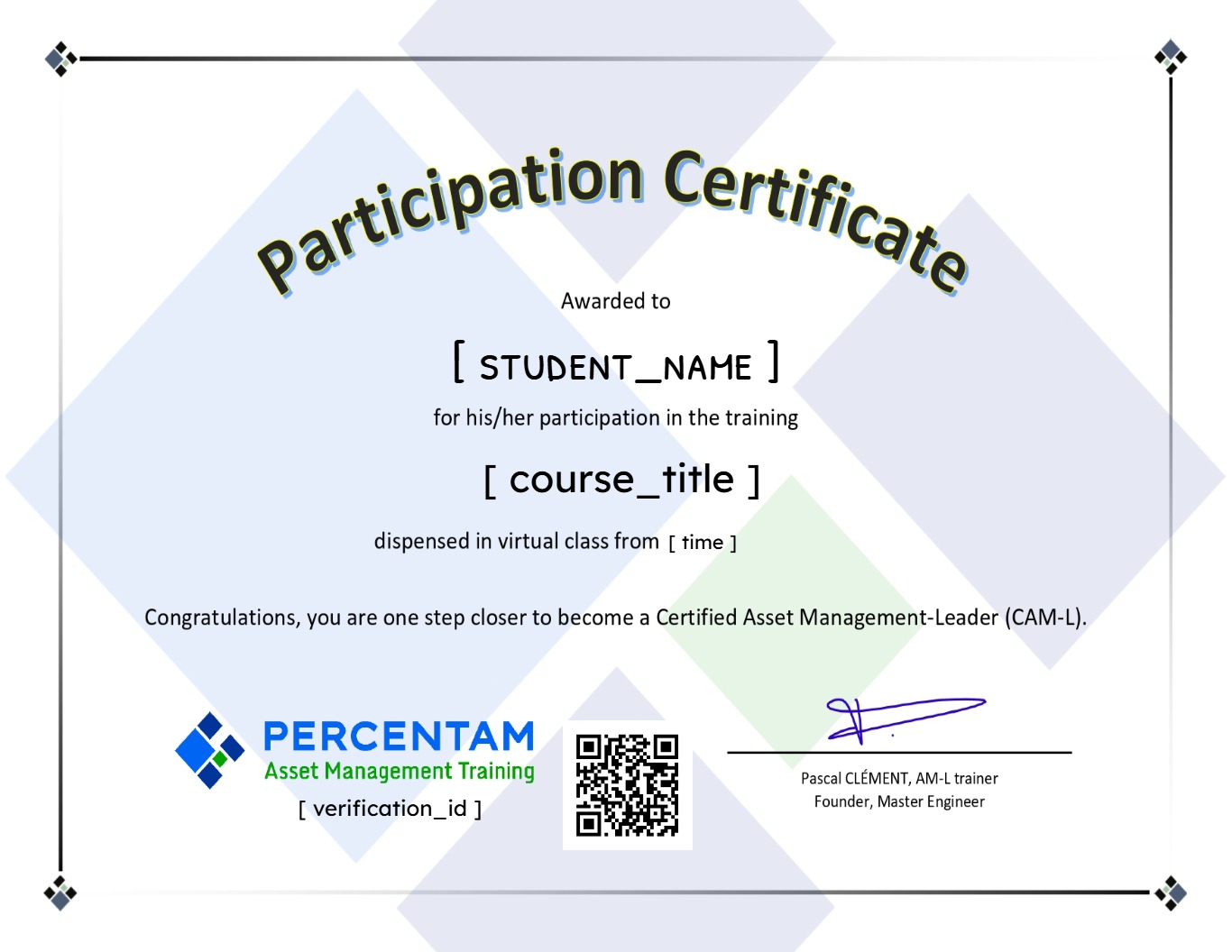
selected template

Student Ratings & Reviews

4.8
Total 12 Ratings
5
10 Ratings
4
2 Ratings
3
0 Rating
2
0 Rating
1
0 Rating
G
6 days ago
I would recommend this training to professionals interested in reliability engineering, asset management, and performance improvement. The course provides a strong understanding of how data analysis supports sustainable operational success.
A
6 days ago
This course provided valuable insights into the role of data in reliability improvement. The concepts were practical and applicable to a wide range of industries and operational environments.
F
6 days ago
The training was well organized and easy to follow. The examples helped explain how reliability metrics and performance indicators can guide improvement efforts across an organization.
OS
6 days ago
I found the course informative and highly relevant to my role. The content provided a solid introduction to reliability analysis and explained how data can be used to support better asset management decisions.
KG
6 days ago
The lessons demonstrated how reliability analysis can help organizations move from reactive decision-making to proactive performance management. This perspective is essential for achieving sustainable operational excellence.
D
6 days ago
This training highlighted the importance of measuring performance rather than relying on assumptions. The methodologies discussed provided a clear framework for evaluating asset reliability and identifying opportunities for improvement.
K
6 days ago
I appreciated the practical approach taken throughout the training. The course explained complex analytical concepts in a way that was easy to understand and apply. It has strengthened my confidence in using data to support operational decisions.
J
6 days ago
The course successfully connected reliability principles with long-term asset management objectives. I gained a deeper understanding of how organizations can use reliability data to improve performance, reduce failures, and support continuous improvement efforts.
L
6 days ago
As a reliability engineer, I found this course extremely valuable. It provided a structured approach to reliability analysis and demonstrated how data can be transformed into actionable insights that improve performance and reduce operational losses.
K
6 days ago
The strongest aspect of this training was its focus on data-driven decision-making. Understanding how to collect, analyze, and interpret reliability data has improved my ability to identify risks and prioritize improvement initiatives.
J
6 days ago
Reliability is often discussed as a maintenance topic, but this course demonstrated its impact on business performance, operational excellence, and sustainability. The lessons were practical, relevant, and supported by real-world applications.
J
6 days ago
This course helped me understand how reliability and data analysis work together to improve asset performance. Before taking the training, I relied heavily on experience and intuition when making decisions. The course showed me how to use data to support decisions and identify improvement opportunities more effectively.
Select your currency