4.80
(15 Ratings)

Total Productive Maintenance: Maximize business performance

Wishlist Share

About Course

Tools to maximize business performance

The participant will go beyond the concepts and tools, to apply the lessons learned to his own context of operation, through workshops especially designed to self appropriate the fundamental principles;
– to understand the type of leadership required for success,
– to develop an inspirational vision align with the corporate values,
– to implement processes and tools to mobilize the workforce towards a common goal,
– to establish a corporate culture ensuring the optimal use of assets.

This training is for people involved or having an interest in the management of physical assets, operational excellence or maintenance engineering, and looking for a new perspective.

Methodology: Through presentations, workshops and analytical exercises, the participant becomes familiar with the concepts of total productive maintenance, so that he can implement it in a sustainable way.
• Presentations (40%), analysis exercises (60%)

Outcome: The participant is outfitted with improvement tools implemented in a robust performance-centered asset management process. He acquires the knowledge prior to mastering the techniques and leadership necessary to establish Total Productive Maintenance (TPM) in a sustainable manner.

Content: This training session includes;
• 1 enthusiastic and passionate trainer who knows how to popularize to really transmit knowledge, tools, concepts and above all, know-how
• 13 lectures, each followed by a quiz to assess the knowledge learned and stimulate thinking
• 7 workshops, where the participant puts into practice the knowledge acquired in his own operational context
• 1 participant manual, including the full presentation, the P-CAM process, workshops, lists of failure modes, causes, remedies, detection methods and associated maintenance activities, definitions and references used
• 1 complete toolbox containing methods of continuous improvement, targeting, failure analysis and causes analysis
• 1 skills mapping tool (matrix)
• 1 nominative certificate of participation

Quality assurance: Training review to be completed after the session.

Assessment of the knowledge acquired by the participant: Quiz with a passing score of 80%, following each lecture.

TRAINING OUTLINE / SYLLABUS

Maintenance concepts (10%)
• Context and definitions
• Types of maintenance
• P-F Interval

Reliability in maintenance (15%)
• Dependability (RAMS)
• Operational indicators
• Availability improvement
• Maintainability improvement

Total Productive Maintenance (75%)
• Origin and concept
• The five principles
• The eight pillars
• Implementation and AM process
• Change management
• Rates, indicators and levers
• Improvement methods and tools

Show More

What Will You Learn?

  • - Define industrial maintenance and related concepts
  • - Define dependability (RAMS), reliability and related concepts
  • - Define Performance Centered Asset Management (P-CAM) and related concepts
  • - Define Total Productive Maintenance, role, objectives and related concepts
  • - Establish a corporate culture ensuring the optimal use of assets

Course Content

Introduction to the Performance-Centered Asset Management training – TPM concept
By the end of this section, the participant will know what is the training about, who is the trainer and what attitudes to adopt to optimize the learning's benefits.

  • Introduction to the “Total Productive Maintenance; Maximize business performance” training
    06:01

Maintenance and reliability concepts
By the end of this section, the participant will understand the basics required to sustainably implement a TPM culture, for the Performance-Centered Asset Management.

Module 3Total Productive Maintenance (TPM)
By the end of this section, the participant will be able to efficiently implement TPM concept and tools, with the right leadership to enforce a Performance-Centered Asset Management culture.

Improvement methods and tools
By the end of this section, the participant will be outfitted with methods and tools for improvement, to ensure the sustainability of the TPM.

Advantages and pitfalls
By the end of this section, the participant will understand the advantages of the TPM as well as how to anticipate its implementation and the pitfalls to avoid in order to be successful.

Extra material
By the end of this extra section, the participant will know about the Asset Management-Leader certification and the vision behind.

Earn a certificate

Add this certificate to your resume to demonstrate your skills & increase your chances of getting noticed.
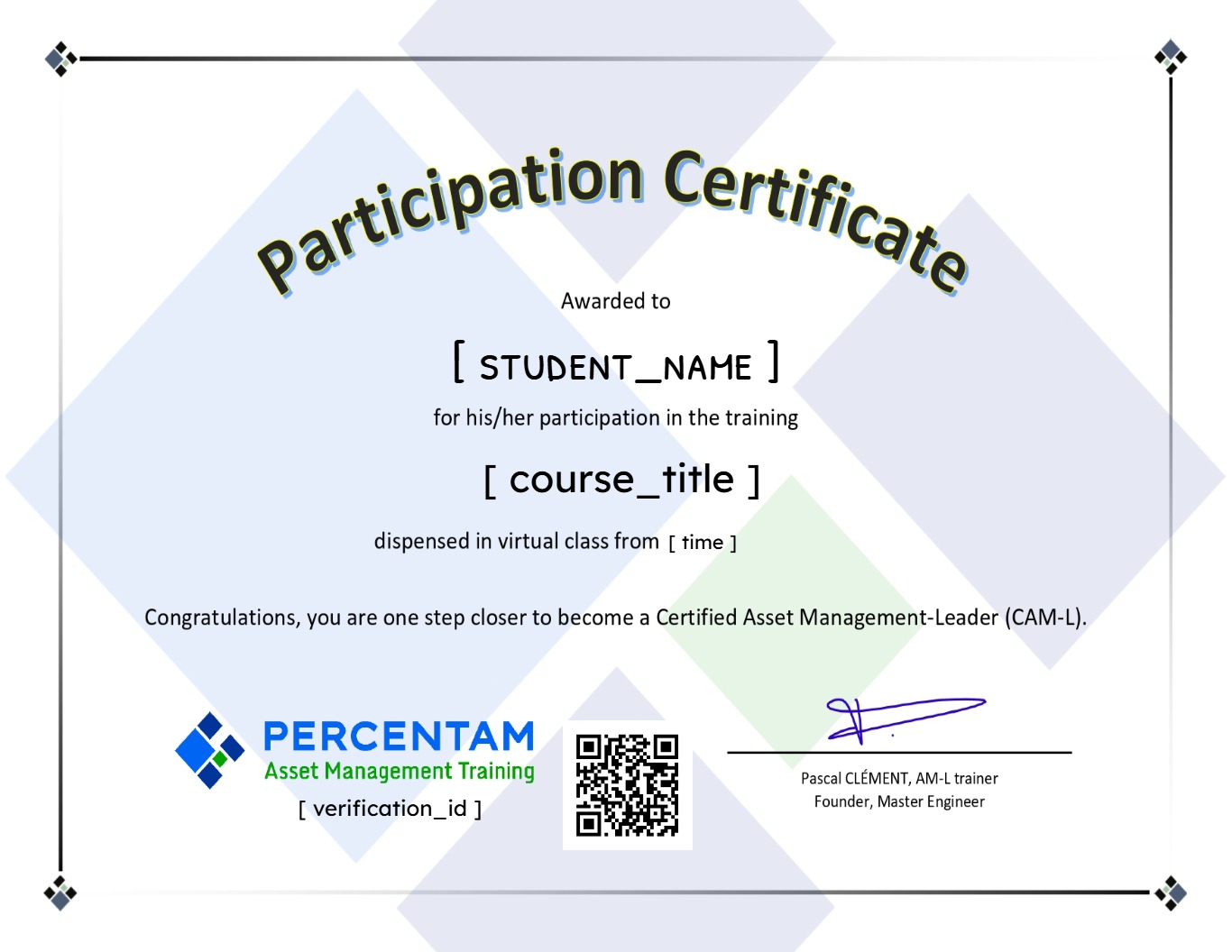
selected template

Student Ratings & Reviews

4.8
Total 15 Ratings
5
12 Ratings
4
3 Ratings
3
0 Rating
2
0 Rating
1
0 Rating
L
6 days ago
This course helped me understand the broader impact of maintenance on organizational performance. The TPM principles discussed can contribute to improvements in reliability, productivity, quality, and safety when implemented effectively.
M
6 days ago
I enjoyed the training and found the material highly relevant to my role. The course explained how TPM can help organizations improve equipment effectiveness while fostering a culture of teamwork and continuous improvement.
R
6 days ago
The lessons were engaging and practical. The course demonstrated how TPM supports reliability improvement, safer operations, and better asset utilization. I would recommend this training to anyone involved in maintenance, production, or operational excellence.
KG
6 days ago
I would recommend this training to professionals seeking to improve operational performance and equipment reliability. The course provides a practical understanding of TPM and demonstrates how it can support long-term business success.
M
6 days ago
The course explained how TPM can help eliminate losses that affect productivity and equipment effectiveness. The practical examples made it easy to understand how continuous improvement initiatives can create measurable results across an organization.
D
6 days ago
The training provided practical insights into reducing downtime and improving equipment performance. I particularly appreciated the emphasis on involving employees at all levels in the maintenance process rather than relying solely on the maintenance department.
K
6 days ago
This course provided a strong introduction to Total Productive Maintenance and its benefits. The content was easy to follow, and the examples helped illustrate how TPM principles can be applied in real industrial environments.
M
6 days ago
The content was well structured and highly relevant to modern industrial operations. I particularly enjoyed learning about the role of teamwork and employee engagement in achieving sustainable performance improvements. TPM is much more than a maintenance program; it is a culture of continuous improvement.
J
6 days ago
What impressed me most was the focus on ownership. The training showed how empowering employees to take responsibility for equipment condition can improve reliability, reduce failures, and strengthen workplace culture. This was a valuable learning experience.
G
6 days ago
As a production supervisor, I found this course extremely useful. It highlighted the importance of involving operators in equipment care and continuous improvement activities. The lessons provided practical strategies that can help reduce downtime and improve operational efficiency.
L
6 days ago
I have worked in manufacturing for several years, and this course helped me understand why some organizations achieve better equipment performance than others. TPM provides a structured framework that aligns maintenance activities with operational goals and business objectives.
J
6 days ago
This course offered a fresh perspective on maintenance management. Rather than focusing only on repairs, TPM encourages organizations to prevent problems before they occur. The training explained how this mindset can lead to significant improvements in performance and reliability.
J
6 days ago
The training provided a clear understanding of how TPM contributes to productivity, quality, safety, and reliability. I appreciated how the course explained the relationship between equipment performance and business performance. The concepts were practical and easy to understand.
K
6 days ago
This TPM course completely changed my understanding of maintenance. Before taking the training, I believed maintenance was primarily the responsibility of the maintenance department. The course showed how operators, supervisors, engineers, and managers all play a role in improving equipment performance. This collaborative approach makes TPM a powerful strategy for achieving operational excellence.
A
6 days ago
One of the most valuable lessons from this training was the importance of proactive equipment care. The course demonstrated how small daily actions can prevent major failures and improve overall equipment effectiveness. I can already see opportunities to apply these principles within my organization.
Select your currency